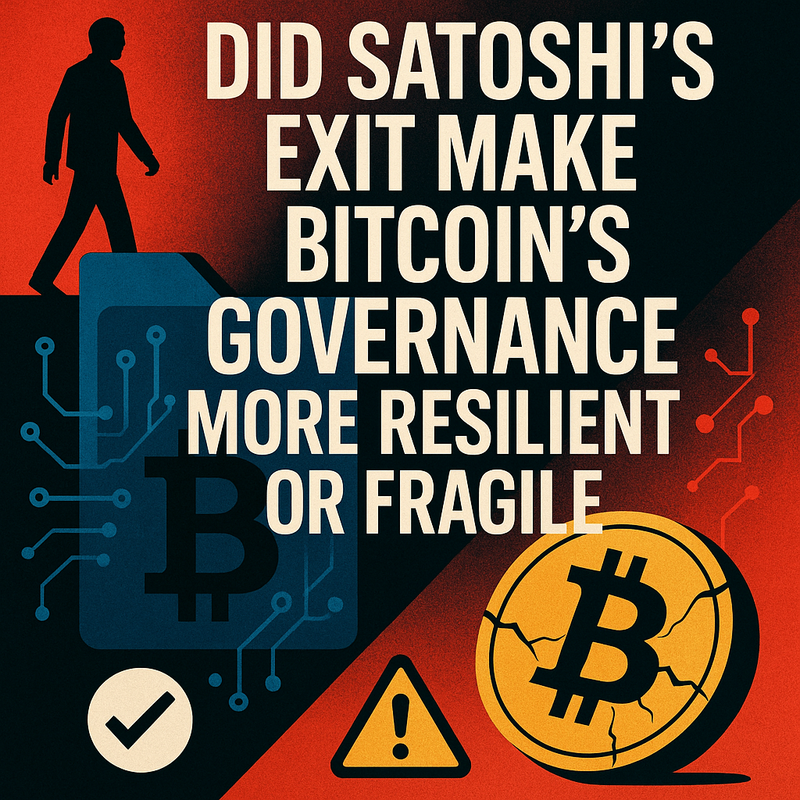
Did Satoshi's exit make Bitcoin's governance more resilient or fragile
Did Satoshi's Disappearance Actually Make Bitcoin Stronger?
The shocking truth about why Bitcoin's anonymous creator had to vanish - and what it means for your crypto investments today
The Billion Dollar Question
What if I told you that Bitcoin's greatest strength came from its creator's disappearance?
While most investors panic about centralization and control in crypto, Satoshi Nakamoto executed the most brilliant exit strategy in financial history.
His vanishing act wasn't abandonment—it was the ultimate test of decentralization.
📈 Pro Insight
Bitcoin's value increased over 100,000% after Satoshi's departure. Coincidence? Or proof that decentralized governance actually works?
The Resilience Blueprint
Why Satoshi's Exit Was Genius
Satoshi didn't just walk away—he engineered Bitcoin's survival by removing himself as a single point of failure. Here's how his disappearance created an unstoppable system:
Decentralized Control
Single Points of Failure
Global Nodes Securing Network
With Central Leader
• Single point of failure
• Vulnerability to attacks
• Potential for corruption
• Limited innovation
After Satoshi's Exit
• Distributed resilience
• Censorship resistance
• Global collaboration
• Continuous innovation
What This Means For Your Portfolio
Bitcoin's decentralized governance proved itself through multiple market cycles, regulatory attacks, and technological challenges.
But here's the reality most traders miss: decentralization creates both opportunity and complexity.
⚡ Trading Reality
While Bitcoin's decentralized nature makes it resilient, it also creates massive volatility and information asymmetry. The whales still have advantages—unless you have the right tools.
Stop Gambling, Start Trading With Precision
Join 15,000+ smart traders who use data-driven signals to navigate Bitcoin's volatility
The Final Word
Satoshi's disappearance wasn't abandonment—it was the ultimate validation of Bitcoin's design. By removing himself, he forced the network to become truly resilient, distributed, and anti-fragile.
But this decentralization comes with a cost: increased complexity and volatility that most traders aren't equipped to handle alone.
The question isn't whether Bitcoin is resilient—it's whether your trading strategy is resilient enough to profit from its designed chaos.